
Brazil’s Atlantic Rainforest is the newest addition to our South America collection, & it is already the trip our office fields the most repeat enquiries about before guests have even landed home. This narrow, fragmented belt of forest running down Brazil’s southeastern coast holds one of the highest concentrations of endemic birds & mammals anywhere on the continent, species found nowhere else on earth, & our Birds of Brazil photography tour was built specifically to put photographers in front of them at close, workable range. This is about why a forest this small, & this threatened, keeps pulling photographers back to it.

Why does so little forest hold so many endemic species?
The Atlantic Rainforest, or Mata Atlântica, once ran almost continuously along Brazil’s coast, & although less than a tenth of its original extent survives today, that surviving fraction is so biologically distinct from the Amazon further north that it has generated its own suite of endemics found in no other forest on the planet. Tanagers in particular have radiated here into a dazzling range of colour combinations, & photographing several genuinely different endemic tanager species in a single session, each restricted to this one narrow coastal strip, is not something replicated anywhere else in South America. That concentration, forced into fragments of forest surrounded by farmland & city, is exactly why the surviving reserves reward repeated, careful attention rather than a single pass through.
Why does feeder & fruit-perch photography work so well here?
Much of the Atlantic Rainforest itinerary works from carefully maintained feeding stations & fruit perches set within the forest edge, a technique that trades the wide, roaming search of a more conventional birding trip for controlled, repeatable access to species that would otherwise flash past overhead in dense canopy. Positioning a perch against a clean backdrop of soft green forest shade, then waiting as tanagers, honeycreepers & the occasional toucan work their way through it, gives a level of control over background & light that simply is not available when you are chasing calls through closed-canopy forest. It is a discipline much closer to hide photography than to conventional birding, & guests who have done both consistently tell us it produces the stronger portfolio.
What makes the light in coastal Brazilian forest different?
July sits within the Brazilian winter, which here means drier, more settled weather & noticeably softer humidity than the forest carries for much of the year, & that clarity translates directly into cleaner, more saturated colour in the early morning sessions when the tanagers are most active around the feeding stations. Mid-morning cloud frequently rolls in off the coast, diffusing the light without killing it, which is precisely the kind of even, shadow-free illumination that suits photographing a bird as intricately patterned as a Green-headed Tanager or a Brazilian Tanager without losing detail to harsh contrast. Afternoon sessions shift toward the forest’s understorey specialists, where working in deeper shade demands a different, more deliberate approach to exposure than the open, feeder-lit mornings.
Why does the toucan matter as much as the tanagers here?
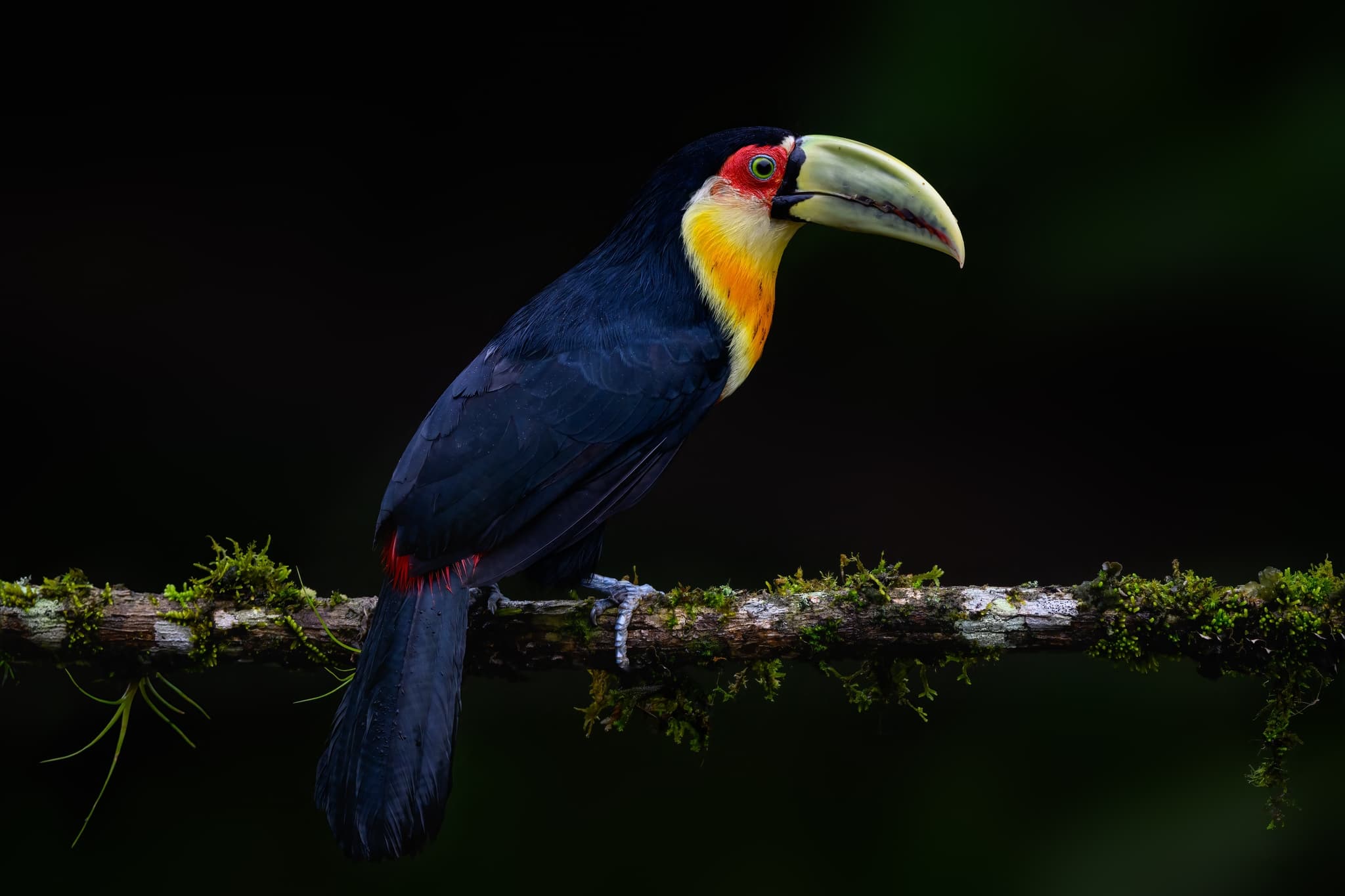
Red-breasted Toucan is the bird most guests arrive hoping to photograph, & its heavy, brightly coloured bill against the soft green of the forest canopy makes an image that needs no explanation to anyone back home, but getting a clean, close frame of one takes more patience than the bird’s boldness in the wild would suggest. Toucans favour fruiting trees at the forest edge & move through the canopy in short, deliberate hops rather than sustained flight, which means a fruit perch positioned correctly beneath a known feeding tree does far more work than searching the canopy on foot ever could. We learned this the hard way in the first season, moving a perch twice before settling on a spot where the light, the background & the toucans’ actual flight lines into the tree all lined up, & that single adjustment now anchors some of the strongest images the trip produces. Surucua Trogon & Channel-billed Toucan add further variety to the same fruiting trees, rewarding a photographer who is willing to sit at one perch for the better part of a morning rather than moving on after the first good frame.
Why is this trip built around variety rather than one signature species?
Unlike a lot of our destinations, which tend to orbit a single flagship species, the Atlantic Rainforest itinerary is deliberately built around breadth: a working day might move from tanager-studded feeders at dawn, through forest trails for antbirds & woodcreepers working the leaf litter, to a fruit perch drawing in toucans by early afternoon. That structure suits a photographer looking to build a diverse portfolio of genuinely difficult, range-restricted species in a short space of time, rather than one chasing a single hero image, & it is part of why guests describe the trip as more intensively productive, frame for frame, than destinations built around a single iconic animal.
This is also one of the newer trips in our collection, first run in 2025, so we do not yet have years of returning guests to point to the way we can with Lake Kerkini or Hokkaido. What we do have is a guide, David, who spent considerable time scouting the specific reserves & feeding stations before the first departure ran, & early feedback from that first group has already reshaped small details of the itinerary, more time at the strongest feeder sites, less at the weaker ones, in exactly the way every trip in this series improves with repetition. That is the pattern this whole series is built on, & Brazil is simply earlier in it than most.
Who tends to get the most from this particular trip?
It suits photographers who already have some experience with smaller, faster-moving subjects & want to apply that discipline to a genuinely different set of endemic species than anywhere else in South America offers. The group is kept small, & because so much of the work happens at controlled feeding stations & fruit perches, it particularly suits anyone keen to refine perch composition & background control rather than photographers chasing a pure sightseeing itinerary. It is less suited to guests who want a single dominant mammal subject; this trip’s reward is genuinely in its variety.
So what will keep photographers returning to Brazil’s Atlantic Rainforest?
It is the sheer density of species found nowhere else on the planet, packed into a fragment of forest small enough to properly get to know across repeated visits, & the knowledge that each return trip, timed differently or spent at a different feeding station, turns up birds the last one did not. That sits alongside the wider case we make for wildlife photography in Brazil in why photographers are drawn to Brazil, & you can read more about the forest’s habitat & species in our field guide to the Atlantic Rainforest. If you would like to talk through a July departure, get in touch & David will explain how the feeder sessions are structured.