
Grímsey Island - often written Grimsey Island in English - sits directly on the Arctic Circle, a small, wind-scoured outcrop off Iceland’s north coast reached by a short flight or a rolling ferry crossing from Akureyri, & it has anchored our Puffins of Iceland photography holiday since 2020, long enough now that Robin, who guides every departure, can predict which stretch of clifftop will be busiest to the week. Few places in the North Atlantic pack quite this density of breeding seabirds onto quite this little land, & this is about why crossing the Arctic Circle for puffins has become something guests want to do more than once.

Why does crossing the Arctic Circle matter for the photography itself?
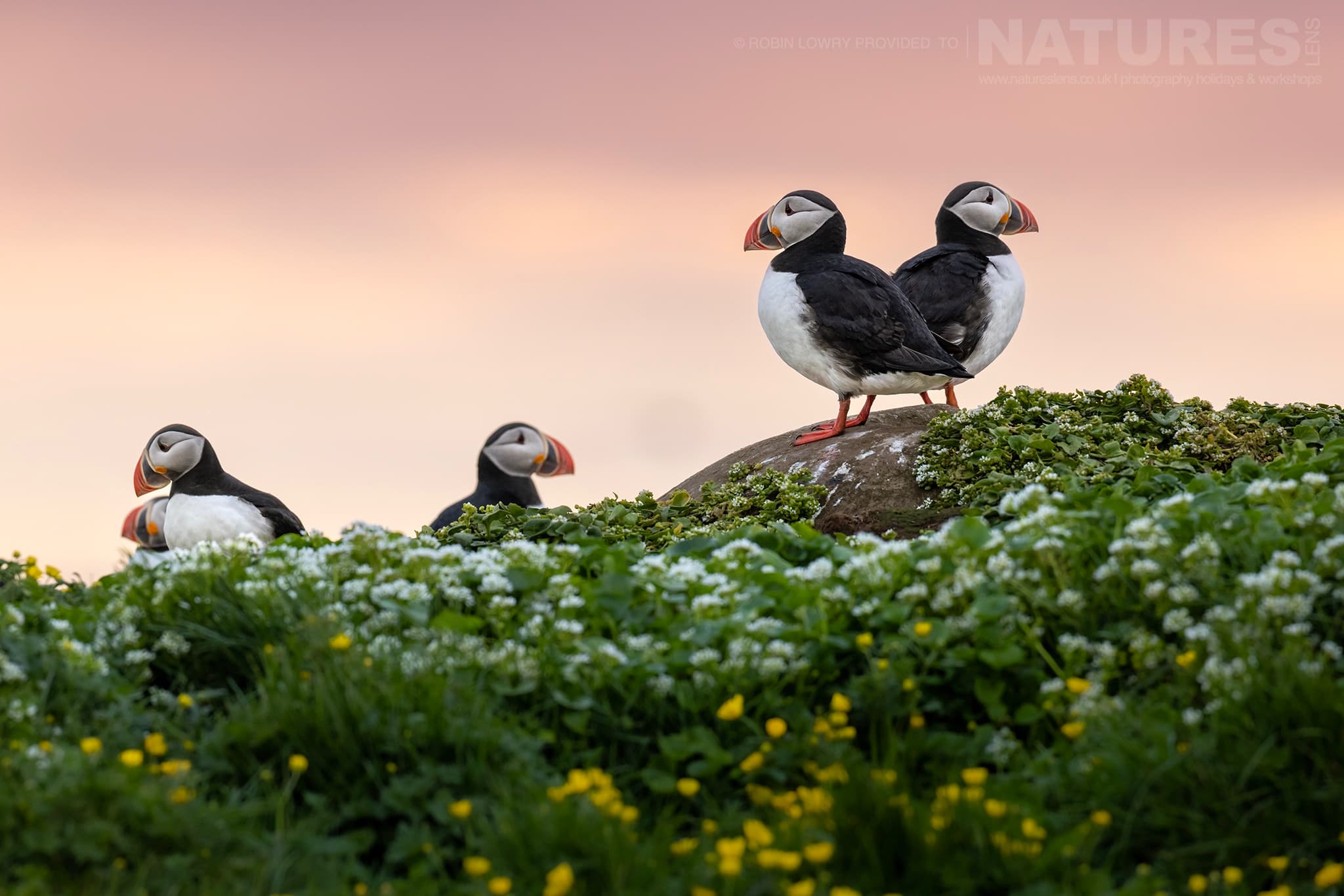
Grímsey’s position, straddling 66 degrees north, gives the island genuinely long summer daylight through late June & early July, extending the useful working window for low, warm light well beyond what a more southerly location can offer, & that extended golden hour is one of the quieter reasons this trip produces such consistently strong results. Atlantic Puffin nests in burrows along the clifftop turf in numbers that rival anywhere else in the North Atlantic, & the island’s isolation, a genuine outpost reached only by plane or ferry, means the colonies see a fraction of the visitor pressure that busier Icelandic puffin sites further south now carry.
Why does the cliff structure suit both portraits & flight shots?
Grímsey’s basalt cliffs drop sharply to the sea, creating natural viewing platforms directly above nesting ledges packed with Black-legged Kittiwake, Common Guillemot, Thick-billed Murre & Razorbill, all stacked in tight colonies that reward a longer lens worked carefully along the cliff edge. That same clifftop vantage doubles as a flight-photography position, since Arctic Skua & Great Skua patrol the updrafts looking to rob returning puffins of their catch, giving genuinely reliable, repeatable flight sequences across a session rather than the occasional lucky pass a lower vantage point would offer. Northern Fulmar rides the same air currents with barely a wingbeat, a useful, more forgiving subject for practising flight tracking before a faster skua chase presents itself. Long-tailed Skua, a scarcer & more delicate relative of its two commoner cousins, occasionally turns up along the same clifftop, & a confirmed sighting is one of the more genuinely exciting moments a returning guest can have, since it rewards exactly the kind of repeated familiarity with the island’s flight lines that only comes from having worked the cliffs before.
What makes the island’s smaller waders & divers worth the extra attention?
Beyond the obvious seabird spectacle, Grímsey’s rocky shoreline & short tundra vegetation hold a quieter cast that rewards patience: Purple Sandpiper & Ruddy Turnstone work the tideline, Red-necked Phalarope spins in tight circles on the island’s small pools in a feeding behaviour unlike almost any other wader, & Red-throated Diver & Great Northern Diver call from the more sheltered inlets. Rock Ptarmigan, still carrying traces of winter white into early summer, & Snow Bunting add further variety across the island’s open ground, & guests who have done the trip more than once increasingly spend deliberate time on this quieter layer having already secured strong puffin & skua images on an earlier visit.
The crossing itself, whether by the small internal flight or the ferry that can run rough in an Arctic swell, is part of what makes Grímsey feel genuinely earned rather than simply visited, & that sense of remoteness carries through into how undisturbed the colonies feel once you are actually on the clifftop. Six years of running this trip has taught us which weather windows make the crossing most reliable & which stretches of cliff hold the strongest light at which point in the long Arctic Circle day, knowledge that shapes the itinerary meaningfully more than a first-time visitor could plan for alone.
Why does the ferry & flight logistics actually shape the itinerary?
Grímsey is small enough, & remote enough, that the itinerary has to be built around the crossing rather than around it, & that constraint has quietly become one of the trip’s strengths rather than a limitation to work around. Rather than a fixed daily schedule, sessions are timed to the island’s actual light & the wildlife’s activity, since once you are committed to being on Grímsey for the trip’s duration there is no pressure to rush back for an onward connection, & that unhurried structure is something guests repeatedly single out as different from busier, more logistically constrained seabird trips elsewhere in Iceland. Akureyri itself, the mainland base before & after the crossing, adds its own quieter photographic opportunities around the fjord, Common Eider working the sheltered water & Glaucous Gull & Iceland Gull loafing along the harbour, a useful warm-up before the crossing proper.
Why does working the same cliff across several sessions change what you capture?
A single afternoon at any one stretch of Grímsey’s cliffs will produce reasonable images, but the trip is structured to return to the strongest sections more than once across the week, at different times of day & under different weather, because seabird colonies photograph completely differently under a flat overcast sky than they do backlit by a low midnight-adjacent sun. Guests who revisit the same cliff edge on a second or third occasion consistently describe seeing details they missed the first time, a kittiwake pair exchanging nesting material, a puffin pausing at the burrow entrance rather than diving straight in, small behavioural moments that only reveal themselves with repeated, patient observation of ground you already know rather than territory you are seeing for the first time.
Who tends to get the most from this particular trip?
It suits photographers who want serious seabird density without the crowds now common at more accessible Icelandic sites, & who are comfortable with a genuinely remote, weather-dependent crossing to get there. The group is capped at seven, & it particularly suits anyone building a dedicated seabird portfolio who wants both intimate puffin portraits & properly challenging flight photography within the same short trip, rather than one or the other.
So what keeps photographers coming back to Grímsey Island?
It is the combination of genuine remoteness, extraordinary seabird density & light that, this far north in summer, simply runs longer than it does almost anywhere else we work. That instinct sits alongside the wider case we make for wildlife photography in Iceland in why photographers are drawn to Iceland, & you can read more about the island’s habitat & species in our field guide to Grímsey Island. If you would like to talk through a late June departure, get in touch & Robin will explain how the crossing & the cliffs work together.